Thursday, February 28, 2013

Preschooler Self-control


Choices.  Go for the impulsive smaller-sooner or the larger-later reward?  These decisions challenge us throughout our lives.  Develop self-control, and choose the wiser larger-later more consistently.  Just as we can see in our everyday experience, researchers find a host of benefits.

But we all know it's not easy.  Starting young helps, but how do we get kids to resist their natural impulse to grab?

In a new article in the Journal of Applied Behavior Analysis, researchers at the University of Kansas checked out a few of the possibilities--for preschoolers.  One of the established methods includes a type of shaping process (called "delay fading"), in which individuals face the same delay to the two choices at first, and naturally choose the larger reward.  The delay to that outcome is then gradually increased.  VoilĂ !  Maybe self-control isn't so hard after all.  Another successful method involves teaching kids to repeat a rule about the benefits of waiting.  A third is providing other activities to help bridge the delay.

In their study, the researchers tested different forms of self-control aids that don't rely on gradually increased delays: (a) provide a timer, (b) include a brief rule, one that's not repeated, and (c) make toys available during the delay.  The delay to the larger reward was only 5 minutes.  Even so, in this case, only (c) reliably enhanced self-control for the children.

Psychologist Walter Mischel famously found that preschoolers who had more self-control in the "marshmallow test" (one marshmallow now, or wait 15 minutes for two) also did better on their college exams many years later.  Self-control matters.  So start 'em young!

Friday, February 22, 2013

For Presidents' Day (US): Sustainability, Consequences, and the "Founding Fish"

As a youngster, I was concerned about where all the garbage and sewage went.  I lived in Chicago, so it was evident there was a lot of it.  Wouldn’t we be drowning ourselves in trash?  OK, in some places that’s a reality . . .

This was clearly not something most people worried much about then (before the environmental movement of the 1970s), a worry in itself.  Perhaps that realization helped contribute to my lifelong concern about "sustainability":  long-term viability for people and planet. I discuss consequences and sustainability in the last chapter of my book.

The problem, of course, is that desirable long-term consequences like sustainability often mean sacrifices now.  Yet, both as individuals and societally, we do sometimes make rational long-term choices, foregoing more immediate rewards. 


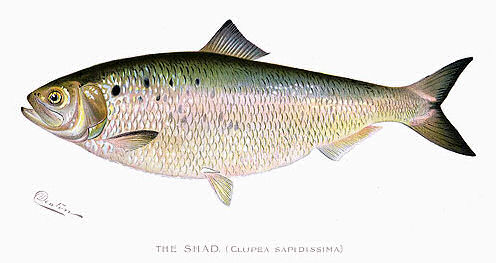
File:Dentonshad1904.jpgIn honor of Presidents' Day in the US, I thought it might be appropriate to provide an example from our early history.  In his book The Founding Fish, John McPhee comments on one little-known example of how consequences eventually brought about conservation--but it took some disasters along the way.  The American Shad was a major source of protein for Native Americans and European settlers alike.  While Native Americans had set up some fish-catching weirs, their harvest was sustainable.  Europeans set up so many of them that downstream weirs began taking too many of the returning fish, so that upstream weirs caught very little.  As a consequence, in the early 1700s, the colonial Pennsylvania legislature passed laws forbidding these obstructions entirely, and requiring the removal of existing ones.  These laws were largely ignored, leading to a full-scale battle in 1738 in which lives were lost.  These fish were that important.  Later, additional sustainability laws were passed.  For example, only a few years before the Declaration of Independence, fishing in the Schuylkill River was banned from Saturday after sunset to sunrise on Monday (1771).  
 It was a start.

Monday, February 11, 2013

The Science of Consequences on NPR! - and Book Touring Update

I'm just back from book touring in Texas and Kansas, where I had a wonderful time giving talks, doing book signings, teaching classes, and chatting about the book.  At the Art and Science of Animal Training conference at the University of North Texas, speakers covered a wide variety of applications of positive reinforcement methods for animals (see my previous blog post "Positive Reinforcement Frontiers with Zoo Animals"--link).  The audience of 200 for my keynote address was my largest yet!  The University of Kansas in Lawrence is my PhD alma mater, so being there felt like going home (and I enjoyed a large turnout there too).  Most of those in the audience are working on human applications such as early childhood education, management, choice, sustainability, community violence prevention, autism, addiction, and general health psychology.  Throughout, I met old and new friends who are excited about this science.

One of the many highlights of the trip was being interviewed on Central Standard, a live radio program from KCUR, Kansas City's National Public Radio affiliate.  If you'd like to listen, here's the link (go to February 7).  You can also download the program.  The segment about the book is first, and lasts 30 minutes.  Let me know what you think!

Wednesday, January 30, 2013

Scientific American Book Club

Just a quick note - The Science of Consquences is a selection of the Scientific American Book Club!  It's under the Biology/Neuroscience category.

Here's the link, for anyone who's interested.