Thursday, February 28, 2013

Preschooler Self-control


Choices.  Go for the impulsive smaller-sooner or the larger-later reward?  These decisions challenge us throughout our lives.  Develop self-control, and choose the wiser larger-later more consistently.  Just as we can see in our everyday experience, researchers find a host of benefits.

But we all know it's not easy.  Starting young helps, but how do we get kids to resist their natural impulse to grab?

In a new article in the Journal of Applied Behavior Analysis, researchers at the University of Kansas checked out a few of the possibilities--for preschoolers.  One of the established methods includes a type of shaping process (called "delay fading"), in which individuals face the same delay to the two choices at first, and naturally choose the larger reward.  The delay to that outcome is then gradually increased.  VoilĂ !  Maybe self-control isn't so hard after all.  Another successful method involves teaching kids to repeat a rule about the benefits of waiting.  A third is providing other activities to help bridge the delay.

In their study, the researchers tested different forms of self-control aids that don't rely on gradually increased delays: (a) provide a timer, (b) include a brief rule, one that's not repeated, and (c) make toys available during the delay.  The delay to the larger reward was only 5 minutes.  Even so, in this case, only (c) reliably enhanced self-control for the children.

Psychologist Walter Mischel famously found that preschoolers who had more self-control in the "marshmallow test" (one marshmallow now, or wait 15 minutes for two) also did better on their college exams many years later.  Self-control matters.  So start 'em young!

Friday, February 22, 2013

For Presidents' Day (US): Sustainability, Consequences, and the "Founding Fish"

As a youngster, I was concerned about where all the garbage and sewage went.  I lived in Chicago, so it was evident there was a lot of it.  Wouldn’t we be drowning ourselves in trash?  OK, in some places that’s a reality . . .

This was clearly not something most people worried much about then (before the environmental movement of the 1970s), a worry in itself.  Perhaps that realization helped contribute to my lifelong concern about "sustainability":  long-term viability for people and planet. I discuss consequences and sustainability in the last chapter of my book.

The problem, of course, is that desirable long-term consequences like sustainability often mean sacrifices now.  Yet, both as individuals and societally, we do sometimes make rational long-term choices, foregoing more immediate rewards. 


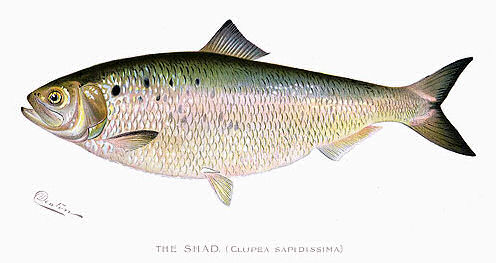
File:Dentonshad1904.jpgIn honor of Presidents' Day in the US, I thought it might be appropriate to provide an example from our early history.  In his book The Founding Fish, John McPhee comments on one little-known example of how consequences eventually brought about conservation--but it took some disasters along the way.  The American Shad was a major source of protein for Native Americans and European settlers alike.  While Native Americans had set up some fish-catching weirs, their harvest was sustainable.  Europeans set up so many of them that downstream weirs began taking too many of the returning fish, so that upstream weirs caught very little.  As a consequence, in the early 1700s, the colonial Pennsylvania legislature passed laws forbidding these obstructions entirely, and requiring the removal of existing ones.  These laws were largely ignored, leading to a full-scale battle in 1738 in which lives were lost.  These fish were that important.  Later, additional sustainability laws were passed.  For example, only a few years before the Declaration of Independence, fishing in the Schuylkill River was banned from Saturday after sunset to sunrise on Monday (1771).  
 It was a start.

Monday, February 11, 2013

The Science of Consequences on NPR! - and Book Touring Update

I'm just back from book touring in Texas and Kansas, where I had a wonderful time giving talks, doing book signings, teaching classes, and chatting about the book.  At the Art and Science of Animal Training conference at the University of North Texas, speakers covered a wide variety of applications of positive reinforcement methods for animals (see my previous blog post "Positive Reinforcement Frontiers with Zoo Animals"--link).  The audience of 200 for my keynote address was my largest yet!  The University of Kansas in Lawrence is my PhD alma mater, so being there felt like going home (and I enjoyed a large turnout there too).  Most of those in the audience are working on human applications such as early childhood education, management, choice, sustainability, community violence prevention, autism, addiction, and general health psychology.  Throughout, I met old and new friends who are excited about this science.

One of the many highlights of the trip was being interviewed on Central Standard, a live radio program from KCUR, Kansas City's National Public Radio affiliate.  If you'd like to listen, here's the link (go to February 7).  You can also download the program.  The segment about the book is first, and lasts 30 minutes.  Let me know what you think!

Wednesday, January 30, 2013

Scientific American Book Club

Just a quick note - The Science of Consquences is a selection of the Scientific American Book Club!  It's under the Biology/Neuroscience category.

Here's the link, for anyone who's interested.

Consequences Without Awareness

Consequences are everywhere--sometimes when we don't even realize it!  The Science of Consequences includes a number of examples of research demonstrating how we can be influenced by consequences for what we do without our awareness.  (Another reason why it's helpful to know more about how they work.)

File:Hugh specs.jpgThis fact was recently brought home to me in an unexpected way.  I was at my optometrist's office, getting my vision checked with one of those eye charts--you know, the standard one with the big E on top, and rows of letters that get progressively smaller and harder to read as you move down. 

The optometrist asked me why I was tilting my head. Was I?  I was!  I hadn't even realized it, it was so well-learned and automatic an adjustment. Tilting my head back a little brought the letters into slightly better focus, as I verified when I experimented, trying to read different rows on the eye chart with my head at different angles.  It wasn't a large effect, but under the pressure of struggling to make out the tiniest letters, tilting definitely helped.  It's almost spooky.


Saturday, January 19, 2013

The Joy of Checklists

After the euphoria of my book launch, a return to reality meant that I began feeling buried in book-related work again.  So I've reverted to a consequence-based technique I took advantage of when I was beginning the research for the book so many years ago:  a variation of the ubiquitous checklist.

Learning is fun and rewarding, so it wasn't hard for me to read journal articles and books.  Taking notes on the important points wasn't hard either.  But categorizing and recording all the notes in appropriate computer documents was time-consuming and tedious.  (I ended up with several thousand pages.)  I tried a number of tricks to help myself keep motivated, such as different schedules of reinforcement:  Work till 3 PM, then take a break.  Or finish entering the notes from this book, then break.  These common techniques can be quite effective.  But not always.  In this case, I still found myself dreading the drudgery.  Could I use my own science to do better?

In one of the classic forms of checklists (there are many), you might make a list of errands to run, or items to buy at the store.  Upon accomplishing each goal, you check it off.  That's frequently rewarding in itself, and can bring a small but noticeable feeling of satisfaction.  At the end of the trip, you get to toss the whole list.  Mission accomplished.

To help with the note-recording drudgery, I simply created a new document in which I summarized what I'd accomplished that day, and I did this as I finished each task (immediate reinforcement). It's not really a checklist, but it's a kissing cousin, I'd say.  For five extra minutes of work each day, the difference in motivation and emotion was significant.  Instead of just working to avoid the negative of lots of notes piling up, I was also working for a positive reinforcer:  the chance to record the completion of a task, and see all those accomplishments add up in black and white.  Clearly I was getting somewhere after all. These sorts of progress markers can help ease any large project along, at work or at home. 

Plenty of research backs up this merely anecdotal evidence, and I provided some examples in the book.  My only question is, why did it take me so long?! 

What works for you?

Sunday, January 6, 2013

Consequences in Literature

Consequences are all over literature, of course, so this could be the first in a long series!  Good novelists frequently understand psychology even though they may never have studied the science.  American novelist William Maxwell (who died in 2000) is a fine example.  His best-known work, So Long, See You Tomorrow, won the National Book Award, and I highly recommend it.

From the start of one of Maxwell's last published stories, "Grape Bay (1941)," comes this description of its shy protagonist:

"When he was six years old his parents died, one immediately after the other, and he went to live with his paternal grandfather, who did not like children.  It did not take him long to learn what it means not to be wanted.  Now that he was grown, his first impulse was always to withdraw before it became necessary, before someone asked him to."

The effects of a history of aversives are presented as straightforward in this case--and so well-learned that the withdrawing, shy personality patterns become automatic ("his first impulse").  The process of overcoming these patterns often makes for a great story, and indeed, that's part of the attraction of "Grape Bay."  

Anyone have any favorite examples to share?